Weekly notesNo. 03
Beyond AGI, freedom, and competence
01 What I’ve been reading
What comes after AGI?
Whether we arrive at AGI no longer seems like a question, as Google starts looking beyond it.
“It was always clear that, in principle, intelligence could progress beyond human level, but the prospect of AGI was far enough off, and surrounded by ample uncertainties of its own, that looking past it felt premature. Now that AGI is coming within reach, we can no longer put off seriously considering what comes next.”
“Human-level AGI has long been the horizon for AI research, but it is far from the upper limit of intelligence. Understanding what could come next, and its implications across science, industry, and society, is the grand challenge ahead for researchers, developers, and policymakers.”
My notes on the essay
One of the first points Genewein makes is that the last decade of AI progress was fuelled by “steady growth in effective compute.” He attributes this to three things: improvements in hardware manufacturing, algorithmic efficiency (“Doubling efficiency is practically equivalent to doubling the stock of physical compute”), and investment in compute hardware.
Combined, these three factors have produced “an overall growth rate of global effective compute stock of at least 10x per year, a factor of 10 billion over ten years.”
“Imagine that this trend holds. A decade from now, for each single AI agent you could run today, you would hypothetically be able to run more agents of the same quality than there are people in the world.”
“A cognitive workload that can be performed by today’s AI systems for $1 billion in compute tokens would cost just $1000 in ten years. Looking only at the last few years gives even steeper estimates: a recent Epoch study finds the consumer price for achieving a fixed score on a set of benchmarks has fallen by more than 13x per year since 2023.”
One idea I found compelling was that functionally superhuman intelligence might not even require true superintelligence.
“Suppose that we do achieve broadly human-level AI. Then there is clearly a major difference between human-level AIs that are slow and expensive to run, and a world where billions of agents act much faster than humans. That quantitative leap in speed and scale might itself be enough to bridge the qualitative gap from AGI to (weak) ASI.”
In other words, human-level intelligence that is faster and far more numerous might be able to solve hard problems and drive progress in ways that make it seem superintelligent (see the Riemann hypothesis below).
Recursive self-improvement
“Unlike typical technological development, improvements to AI could directly speed up subsequent gains, leading to an accelerating rate of progress. However, further improvements in research tend to be ‘harder to find’: more and more effort is required to maintain the same rate of improvement across technologies. Whether RSI leads to ‘runaway’ progress is largely an empirical question.”
Slowing down isn’t simple
The news is currently filled with calls for AI development to slow down. While there may be a case for a slowdown, Genewein notes it might not be simple.
“Because there are multiple routes to superintelligence, trying to slow down AI development by restricting just one area, like the computing power for training an AI model, won’t be enough to stop overall progress. Equally, suppressing a single dimension risks creating a capability ‘overhang’: if multiple inputs need to be combined to make progress, holding back one dimension while the others move forward would lead to sudden, steep jumps in progress when the suppressed dimension is relaxed (or overcome otherwise).”
02 What I learned
A Nolan chart turns the one-dimensional left-right political spectrum into a two-dimensional diamond
The general view is that liberals believe in more personal freedom but less economic freedom, while conservatives believe the opposite. Libertarians believe in both personal and economic freedom, while authoritarians believe in neither.
Artificial superintelligence (ASI) might already be here, despite not yet having artificial general intelligence (AGI)
On November 20th, Anthropic mathematician Levent Alpöge announced a proof of the Riemann hypothesis, found working with Claude.
I’m no mathematician, so I won’t pretend to understand the hypothesis, the proof, its difficulty, or its significance. But the hypothesis is 167 years old, and it seems every serious mathematician considered it one of the hardest problems in the field. Focused efforts to solve it began in 1900, so for over 125 years the best mathematicians of every generation worked on it without success.
In October of this year, Terence Tao, arguably the most famous living mathematician, said that solving it would take “something beyond current AI,” and estimated 2050. A week before the proof was released, prediction markets had it forecast for 2035.
Narrow superintelligence
I think by definition, the fact that an AI model was able to do something humans couldn’t means it’s “super,” at least in some regard. It just might not be the superintelligence everyone is simultaneously excited for and terrified of. At least not yet.
The strange thing is that despite being able to solve the world’s hardest math problems, an individual Claude agent is still unable to do a lot of things an average human can do. Which is why there’s no consensus yet that the labs have cracked AGI.
There’s a concept called the jagged frontier, illustrated below. The idea is that AI can become superhuman in certain jagged ways while still being subhuman in others. On the progression below, the Riemann hypothesis and the other long-standing math problems AI systems are solving represent the jaggedness. Math is clearly something AI is already superhuman at, despite us not being at AGI yet.
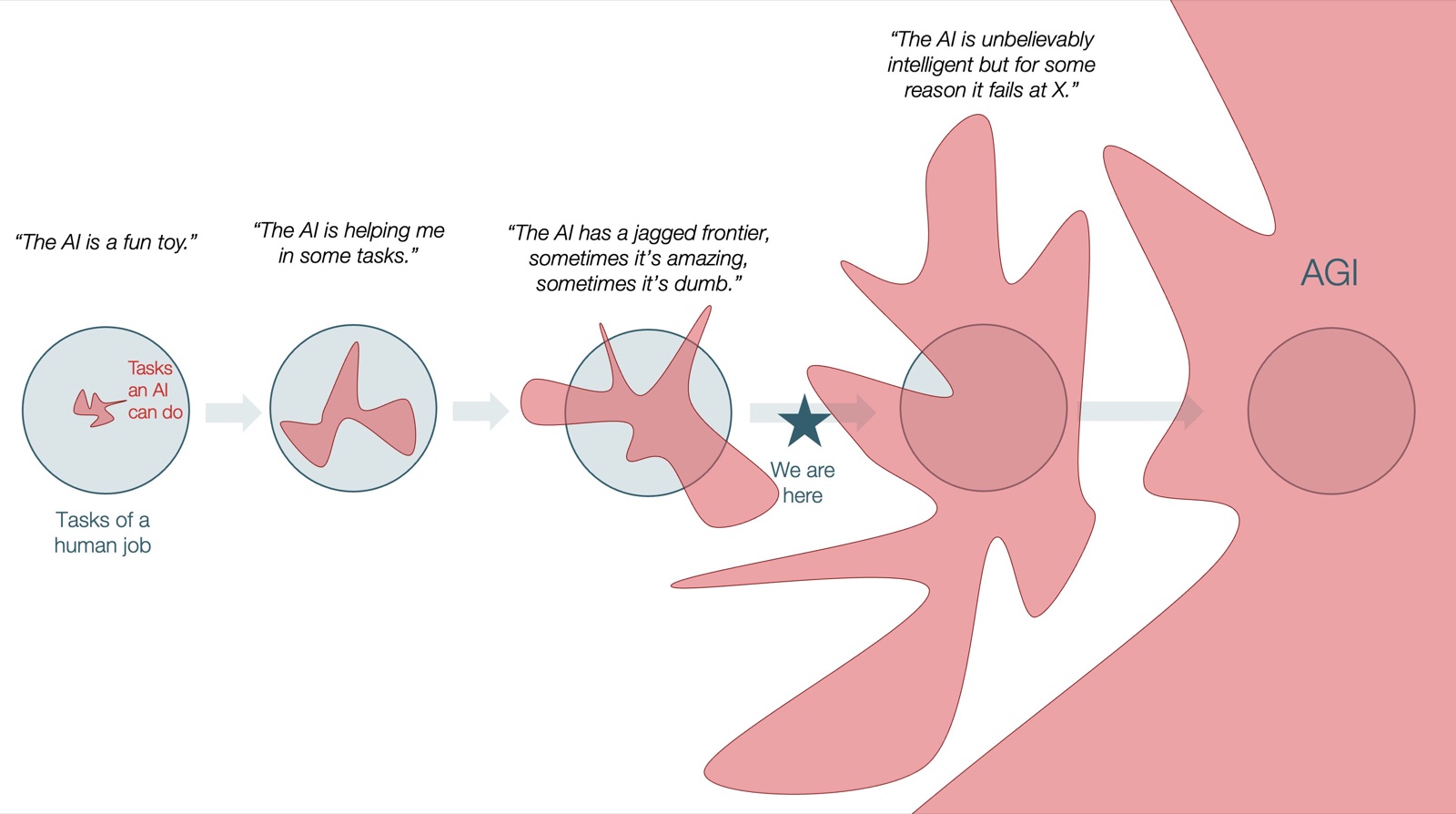
Elon Musk recently posted on X that he sees the AI system behind Tesla Full Self-Driving as superintelligence. That can be argued, as there are still edge cases the cars get wrong that human drivers don’t. But for all intents and purposes the cars are now basically fully autonomous, able to drive you point to point with no intervention. And to Elon’s point, the safety data seems to suggest Tesla’s system is a better driver than most humans.
So if we have models that are superhuman drivers, and models that are superhuman mathematicians, do we have superintelligence?
Most would say no, including me (I think, at least). Most of us have been expecting AGI, then ASI. First we develop an AI that is as good as most humans at everything. Then we turn up the dial, the AI becomes better than humans at everything, and we call it ASI.
Right now we have narrow ASI, and we’re damn close to AGI. Broad ASI is where things likely get crazy.
This is why researchers at Google (in the essay above), and others in the space, are trying to brace for impact.
Alexandr Wang, Meta’s chief AI officer, just posted on X that “Superintelligence is arriving.”
We should probably take him seriously.
03 What I’ve been thinking about
Am I a liberal, a conservative, or a libertarian?
It’s common to hear, and I frequently say, “I’m socially liberal but economically conservative.”
Looking at the Nolan chart above, I’m essentially saying I take the liberal stance of lots of personal freedom, and the conservative stance of lots of economic freedom. So does that make me a libertarian?
Going down the libertarian rabbit hole has left me with one main takeaway: none of this is simple, and I don’t have perfect answers yet.
Early thoughts
The core question I’m sitting with is how involved government should be in our personal lives and our economic lives. My instinct is to say very little in either. Mostly because becoming an adult has made me realize that very few people have their shit together, and there are no real “grown-ups.” I have struggled with, and find myself rebelling against, the paternalistic idea that someone else knows better than I do about my own life and finances. As long as my actions aren’t hurting anyone else, I’m allergic to someone telling me what I can and can’t do.
Kids
Where it gets complicated is kids. There are plenty of ways parents can be negligent, and it feels reasonable for the state to step in on behalf of children: seatbelts, car seats, making sure they’re fed, cared for, and educated.
The economy and welfare
Economically, I lean more conservative. I’m sceptical of free handouts and an overly bloated welfare state aiming for equality of outcome instead of equality of opportunity. There’s inequality in effort and inequality in intelligence, and when people combine those to build great things, they should be rewarded.
At the same time, what about the people who aren’t able to build a dignified life on their own? We all want to displace that obligation and say, “It’s not my responsibility.” But if it’s no one’s responsibility, they get no help, and that’s sad. In my heart, I’m still a liberal. I want to reduce suffering for people and animals, and I care about the planet.
Does it work practically?
Then there are practical areas: healthcare, roads, schools. I don’t yet understand how money pragmatically flows from private citizens and industry to make sure everyone has access to basic infrastructure. Without government-funded healthcare, I’m sceptical people in lower income bands would get the care they need. Even something as basic as roads: imagining neighbours all pitching in to build and maintain them sounds like a recipe for complexity and arguments. Same with schools.
It’s complicated, and I genuinely don’t know where I land yet.
Despite voting against him, I’m glad to have Carney as my prime minister when I look at Trump
I’m of the opinion that Canada, as a country and as an economy, is in a tough spot. It’s clear to me and many people I speak to that we aren’t living in the Canada of 15 years ago. And I mean that in a bad way.
Whether accurate or not, I attributed that to leadership, which for the last 11 years has been the Liberal Party. As a result, despite being liberal at heart, in the most recent federal election I voted for the Conservative leader, Pierre Poilievre. It felt like a decision where my brain overpowered my heart.
It’s impossible to know how things would have turned out had Pierre won, so I can’t say I necessarily regret my decision. But watching what has happened in America has made me glad to have Carney.
Brain over heart
I think Trump won because a lot of Americans did the same thing I did. They felt like they were voting with their brains over their hearts. Americans, like me, were sick of wokeness, corruption, wars, and a flailing economy. They voted in Trump because he convinced them he was the answer.
While he might have been a temporary cure for wokeness, that’s about the only policy promise he fulfilled. He might be the most corrupt president ever to hold office, lining his pockets with crypto scams and rather blatant market manipulation. And while the stock market may have pumped to all-time highs, the underlying economy is struggling, with inflation putting pressure on many people’s ability to afford a dignified life.
A lot of Republican policy I agree with, and a lot of Canadian Liberal policy I don’t. Trump is funny, charismatic, and a strong presence in a negotiation. But I’m not a fan of his character, and it’s a bad look to have him running things. Carney, even if I disagree with parts of his policy, seems like an educated guy with a head on his shoulders. At least I feel like I can count on him to read briefings and think hard about decisions instead of acting on emotion and shitposting online.
Would I rather have a competent leader who is slightly misaligned with my policy opinions, or an incompetent leader who shares them?
It’s an interesting lens through which to view Trudeau, Trump, and Carney. You can argue far-left woke ideology hurt Canada, or you can argue it was Trudeau’s incompetence. Same with Trump on the conservative side. Is far-right Republican ideology to blame for American decline, or is it just Trump’s incompetence?
Maybe regardless of whether you’re right-wing or left-wing, if you’re incompetent and running something as complicated as a country, you’re going to mess it up.
Defining competence
Defining competence isn’t easy, but for an elected world leader it’s probably something close to successfully enacting the policy you ran on.
I’m not a Carney fanboy, and I’m still undecided on whether he’s going to be able to save Canada. I don’t even know if failing to save Canada would prove him incompetent. It may be a fool’s errand.
But I wonder if some right-leaning Canadians voted for him over Pierre Poilievre not because they suddenly moved left, but because they felt slightly left-leaning competence was a better bet than risking right-leaning incompetence.