Weekly notesNo. 02
Weird ideas, risk, and chosen obligations
01 What I’ve been reading
Not Boring
I stumbled upon a treasure trove of essays by Packy McCormick, a technology investor and writer. He writes under the name Not Boring, and his stated mission is to make the world more optimistic. He believes the future could be considerably better than the present, and that understanding the people and technologies building that future is worthwhile.
He’s written over 600 essays and is still going, so expect them to make regular appearances here as I slowly work through them.
Take Weird Ideas Seriously
“The people who change the world are the ones who take weird ideas seriously.”
My notes on the essay
McCormick starts with the surprising fact that Isaac Newton believed in alchemy. He makes a strong case that Newton’s out-of-the-box thinking, and many of his discoveries, came from taking alchemy’s weird ideas seriously.
“Newton was the physicist he was because he took weird ideas seriously.”
He draws an important distinction between believing every weird idea and taking weird ideas seriously. The recommendation is to avoid dismissing ideas simply because they’re weird.
“On the individual level though, there’s a risk, because most weird ideas are wrong. Chances are that the weird idea that grabs you is wrong too. You might spend months, years, or decades chasing something that turns out to be a dead end. You should take that risk anyway, not because you’ll necessarily be vindicated, but because pursuing an idea that grabs you transforms how you think about everything else. Newton’s alchemy was incorrect, but it made him Newton.”
“On the societal level, weird ideas are how we avoid getting trapped in locally stable but globally suboptimal equilibria.”
“Every complex adaptive system faces a choice: explore or exploit. Do you optimize the thing that’s already working (exploit) or seek altogether better alternatives (explore)?”
This is where McCormick introduces local versus global maxima. In 1989, Stuart Kauffman published a paper on the NK model of rugged fitness landscapes. I haven’t read it yet, but I will soon, because it connects to an interesting idea.
“You can think of a rugged fitness landscape like a mountain range with peaks of different heights. If you’re climbing a smaller hill, improvements can get you to the top of that hill, the local maxima, where you get stuck. Any move you make takes you back down the hill; you’re trapped.”
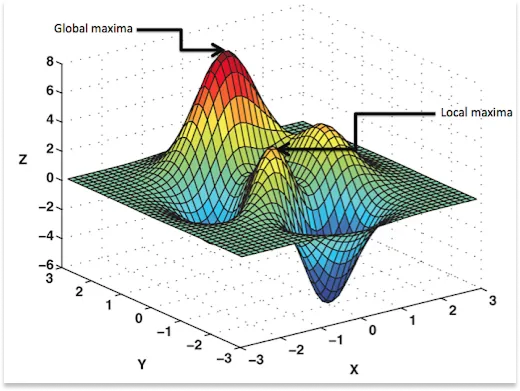
McCormick seems to be arguing that optimizing the things that already work, while useful, risks landing you on a local maximum. It’s seeking altogether better alternatives (exploration) that lets you find the global maximum.
He suggests that in the current AI race, companies are over-focused on optimization. To achieve a genuine leap in intelligence and capability, we might need something completely different, something that can only be found through exploration rather than exploitation.
And of course, the broad thesis of the essay is that being able to take weird ideas seriously helps with that exploration.
Riskophilia
“Over the weekend, a paper in The Journal of Pediatrics titled Decline in Independent Activity as a Cause of Decline in Children’s Mental Well-being: Summary of the Evidence swept the internet.
The authors argue that ‘a primary cause of the rise in mental disorders is a decline over decades in opportunities for children and teens to play, roam, and engage in other activities independent of direct oversight and control by adults.’
My thesis is that it’s not just the kids.”
My notes on the essay
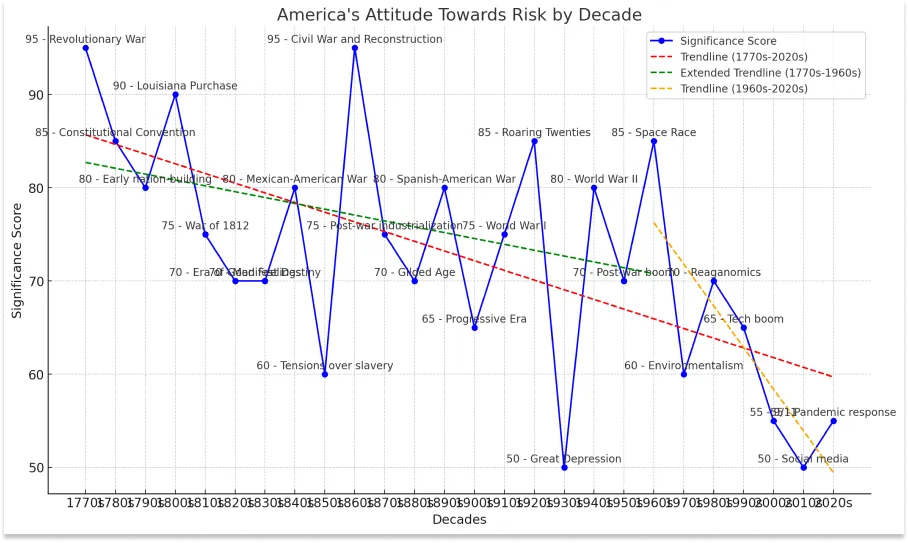
McCormick had ChatGPT estimate America’s attitude toward risk for every decade since its founding. He acknowledges it’s unscientific, but it’s interesting to picture America on a jagged but consistent trend downward.
“Inspired by the German environmental movement, which called it ‘Vorsorgeprinzip,’ or foresight principle, the 1970s also birthed the precautionary principle. In simple terms, it means ‘better safe than sorry.’ In less simple terms, the precautionary principle suggests that if an action or policy has the potential to cause harm, in the absence of scientific consensus, the burden of proof falls on those advocating for the action or policy, not those opposing it.
It’s guilty until proven innocent for new things, but worse, because it forestalls the opportunity for a trial in the first place.”
“In a 2005 paper, The Precautionary Principle as a Basis for Decision Making, Harvard legal scholar Cass Sunstein argues ‘that the precautionary principle does not help individuals or nations make difficult choices in a non-arbitrary way. Taken seriously, it can be paralyzing, providing no direction at all.’”
“We trade freedom not for safety, but for the illusion of safety.
Illusion, because: you can’t eliminate risk.”
“Whether we’re talking about parenting or regulation, the idea that you can is comforting. It provides a sense of control. Everyone wants their kids to be safe. But risks don’t operate in a vacuum. By trying to limit known but potentially small risks, you open yourself up to bigger but less legible risks elsewhere.
Embracing risk can make you antifragile by building resilience and adaptability; running from it can make you fragile by removing opportunities to build the same.
That’s what the parenting paper argues, and I argue that the same thing is true for adults, companies, and even nations.”
“There were a million different reasons that 1971 was a turning point from growth to stagnation: oil shocks, the shift from manufacturing to services, declining energy usage, the abandonment of the gold standard, increased regulation. But I think it runs deeper than that, to the cultural core of the country, which is why the same pattern shows up in the economy and in the way parents raise their kids.
The shift from optimism to pessimism, from growth to degrowth, from hope to doom, and from riskophilia to riskophobia was the result of a cultural movement, and we need a cultural movement in the other direction to get our swagger back.”
This reminds me of the argument in Boom: Bubbles and the End of Stagnation. Boom reshaped how I think and made me excited about the future. I’ve read it twice, recommended it countless times, and it’s on the bookshelf.
“Kids should ride bikes with their friends, but they should wear a helmet. They should roam freely, but they shouldn’t go to bars. We should embrace nuclear energy, but we should build containment domes. We should protect the environment, but we shouldn’t let every bobwhite quail egg stand in the way of a better future for humans. Every decision has costs, and benefits.”
Annie Duke’s ideas make another appearance. Every decision is a bet. To become better decision makers, we need to get comfortable with uncertainty and risk.
“I have good news and bad news: we are not children.
There is no parent to protect us, and even if there were, it might do more harm than good. So drop the illusion. Embrace risk. Roam free. Live vigorously.
The reason we’ve made so much progress over the past half-century despite our decelerating risk appetite is that a brave few have chosen to take risk on and win. I write about the entrepreneurs among them, but they’re everywhere. Someone probably pops to mind for you.
Imagine what the world could be if more of us joined them. We are competent, responsible, and resilient. We have the freedom to engage in activities that involve some degree of risk and personal responsibility. Embrace it. Join the movement.”
“The only way out is up, even if it’s a little risky up there.”
02 What I learned
Much of the world lives with a baseline risk of Zika-related birth defects
Zika is a virus spread by mosquitoes. For most people who catch it, it’s relatively harmless, comparable to a common cold. But it carries significant risk during pregnancy, because it can cause serious birth defects.
A number of countries have regular enough Zika outbreaks that medical advisories recommend avoiding them while pregnant, or avoiding conception for a while after travelling there.
Which got me thinking. What about the people who live there?
What got me thinking about this
My wife and I are planning for kids soon, but first we want to do some honeymoon travelling, spending the winter in Southeast Asia.
Being the planner I am, I started trying to work out when we should start trying to conceive, so that we can enjoy the trip without having to wait too long before actually having a baby. The nine-month wait is quite inconvenient.
My intuition was that we’d start trying while in Asia, until I learned that the tropical countries on our itinerary carry a risk of Zika.
Concerningly, Zika can be asymptomatic, and can affect the baby even if it was caught before conceiving. The recommendation is to avoid conceiving until two months after a potential Zika exposure for the mother, and three months for the father.
This means that if we stay in Asia all winter, we’ll have to wait at least three months after getting home before trying.
What about the people who live there?
All things considered, delaying our baby plans three months so we can spend the winter in the sun isn’t that bad.
But what about the hundreds of millions of people who never leave places with Zika risk? Clearly they just get pregnant anyway and accept the risk we’re urged to avoid.
It reveals an interesting asymmetry in how we approach risk.
For me
Zika is a temporary consideration that’s easy to avoid: change the itinerary, head home early, or wait three months after getting home.
For someone who lives there
It’s likely just merged into the existing set of pregnancy risks everyone has to accept.
Here in Canada there’s a non-zero risk our baby might have a developmental disorder through no fault of our own. Rates of autism are rising, Down syndrome is largely stable but present, and all sorts of other conditions show up through an unlucky roll of the dice. We all know pregnancy carries risk. We accept it and proceed.
I suppose living in a Zika-affected area involves a similar mindset, with Zika as one more risk on the list.
It’s also worth remembering that there aren’t inescapable swarms of Zika-infected mosquitoes roaming these regions. Infection rates vary by location and season, but it’s always a small share of the population. And of women infected while pregnant, only around 5 to 10% go on to have a baby with Zika-related birth defects, with the highest risk in the first trimester.
So the risk is quite low. It’s just one that those of us living outside Zika-affected areas don’t have to take on at all. Thankfully.
03 What I’ve been thinking about
Is it ever OK to physically discipline a child?
Partly because kids are on the horizon, but mostly because I saw a video that left me morally conflicted, and led to a deep conversation with my wife about approaches to discipline.
The reflex answer is no. But there’s a lot of nuance here.
The nuance
Like most things, we first have to figure out what we’re actually talking about.
“Child” as a blanket category isn’t helpful. Age is a spectrum, and we all understand that a four-year-old is different from a twelve-year-old in more ways than one. They’re different in what it’s reasonable to expect from them, in their ability to understand the consequences of their actions and the motivation behind different forms of discipline, and in their ability to communicate and understand us.
“Physical discipline” also exists on a spectrum. Grabbing a child by the arm hard enough to convey seriousness, but not hard enough to hurt, is not the same as punching them in the face with a closed fist. Those two examples are far enough apart to make the sentence seem ridiculous, but it’s important to point out that not everyone means the same thing when they talk about physical discipline.
The video
A father, clearly upset, had found out that his son was bullying a boy half his size, and a girl, to whom he said vile things like “you should kill yourself.”
Right off the bat, as a viewer, my emotions are high. I imagine myself in that situation, feeling like I’d failed as a father. Then I start wondering what this guy is like as a father, and to what degree he actually did fail, or whether life just took a sick turn and this happened through no fault of his own.
Either way, the video then shows his scared son in boxing gloves and headgear. The father records himself forcing the kid to spar with him (rather unsuccessfully). My gut reaction was: good, teach this little shit a lesson. Telling little girls to kill themselves. Show him that not only will that not stand in this household, it won’t stand in this world.
But then the dad throws two, admittedly quite soft, punches, and the kid breaks down in hysterics. Whether he’s crying because it hurt (I doubt it) or because of the overwhelming emotions of the situation, seeing a kid cry like that is hard to watch. That’s where the conflict comes from.
On the one hand
I think the kid deserves it. I imagine being the father of the girl he told to kill herself, wanting to hit him myself. I like knowing his dad is handling that for me.
On the other hand
He’s a kid.
Punishment or discipline?
There’s a lot to unpack here, philosophically and psychologically. First we have to ask: what is the purpose of the hit? Is it punishment or discipline? Discipline implies teaching, an attempt to correct behaviour. Punishment can exist without any desire for learning, or even any expectation that the behaviour will change.
This extends to how we handle criminals as a society. Is the purpose of jail to punish people for their crime? To rehabilitate them? Or to deter crime through fear of punishment, either future crime by the person we’ve locked up, or crime by people outside the system who are afraid of ending up in it?
People smarter than me have gone back and forth on this without a clear resolution, so I won’t claim to know the right answer. I just want to acknowledge the conflict. Somehow I see both sides and can argue both positions.
I understand and respect the argument that punishment for its own sake may have no moral basis, and should exist only to correct behaviour. And if there’s no reason to think a punishment will actually correct or deter behaviour, maybe it should be reconsidered.
But I can also put myself in the shoes of a friend or family member of someone who was the victim of a horrific crime. It’s easy to imagine wanting horrific punishment for the perpetrator, purely for its own sake. Even in the comparatively minor case of this kid bullying other kids at school, some part of me wants to see him punished.
The saner, more rational part of me wants to understand what led him to do this, and to empathize with whatever internal struggle he’s going through. I want to see those issues resolved in a way that reshapes him into someone who won’t keep making mistakes like this.
Frankly, it’s a genuinely open question in my mind whether physical discipline, wherever on the spectrum it lies, would work toward that aim.
The obligations we choose
There’s a difference between obligations imposed by others and obligations you impose on yourself.
Most of the obligations imposed by others come from work. To me, the most exciting prospect of retirement is a dramatic reduction in the obligations other people set for me. Naturally, that frees up more space for self-imposed ones.
Retirement, writing, and working out
I spend a lot of time thinking about retirement. I think it’s important to define it well, so we know what we’re aiming for and give ourselves a better shot at getting there early.
Naval Ravikant defines retirement as a state of mind rather than a traditional age or financial milestone:
“Retirement is when you stop sacrificing today for some imaginary tomorrow. When today is complete, in and of itself, you’re retired.”
A little more practically, it’s having enough money to support yourself so you no longer need to do things you don’t want to do for money. By definition, work is stuff you don’t want to do. And most of us work most of our lives so we have money to survive and afford whatever degree of luxury we feel we want or deserve.
I’ve got a lot of thoughts on this, most of which will have to evolve in future writing. But at a high level, I think all of us should strive toward this form of retirement. Notice that under this definition, you don’t necessarily have to stop doing things that earn money. You just get to stop doing the things you don’t want to do: the things you do despite not wanting to, so you can pay your bills. Most of those are obligations set by others.
Writing as an obligation
At some point this week, I caught myself feeling like I “had” to sit down and write so I’d have something to publish today. I realized that this sense of obligation implied writing wasn’t what I wanted to do in that moment.
I’ve had this romantic idea of spending my days doing mostly what I want, with very few obligations. So it gave me pause when writing, something I chose to do and didn’t need to do, felt like an obligation rather than a want.
I might not want to sit down and write in a given moment, but that’s short-term resistance. Zooming out, having a body of written work is something I do want. So writing is both a want and an obligation.
If a body of written work was something I didn’t actually want, but was placed on me by someone else, then it’s obligations all the way down, and somewhat miserable. But if I’m the one who wants the body of work, I either write despite not wanting to in the short term, or risk failing to get what I want in the long term.
Using your wants as a guide in every moment doesn’t work. Short-term wants aren’t always aligned with medium- and long-term wants, and committing to the longer-term ones can feel like an obligation in the short term. Waking up every day and doing whatever you want is nice for a bit, but over a longer time frame you realize you aren’t doing the medium- or long-term things you want.
Working out
Exercise is a great example. I enjoy the process of working out, though I know that’s not true for everyone. I still feel resistance to getting started, even though it’s pleasant once I do. So every now and then I catch myself saying “I have to work out,” rather than “I want to work out” or the neutral “I’m going to work out.”
In the more resistant moments, when I’m lacking motivation, the workout feels like an obligation. But it’s tangibly different from the obligations we face all day at our jobs. It’s an obligation to myself: one in the short term, in pursuit of something I actually want in the long term.
The goal shouldn’t be a life without obligation, but a life with fewer obligations set by other people.
Naval’s definition can sound like retirement means never trading today for tomorrow. But I don’t think even a fully retired day is free of that trade. The difference is that the tomorrow you’re working toward isn’t imaginary, and it isn’t someone else’s. It’s one you chose.
Wanting something doesn’t make it wise